News & Analysis
October 6, 2026
Multiple U.S. Supreme Court justices asked pointed questions of oil industry lawyers during oral argument in Suncor v. Boulder on Monday, as the court considers Big Oil’s bid to escape accountability for lying to the public about climate change. The justices will now decide whether Boulder, Colorado’s climate deception case against ExxonMobil and Suncor Energy can move toward discovery and trial.
“Big Oil’s desperation to escape trial for climate deception is still in search of a legal justification,” said CCI Legal Director Corey Riday-White following the argument. “Justices across the ideological spectrum asked good, skeptical questions that poked holes in Big Oil’s attempt to stop Boulder’s case before it can go to trial.”
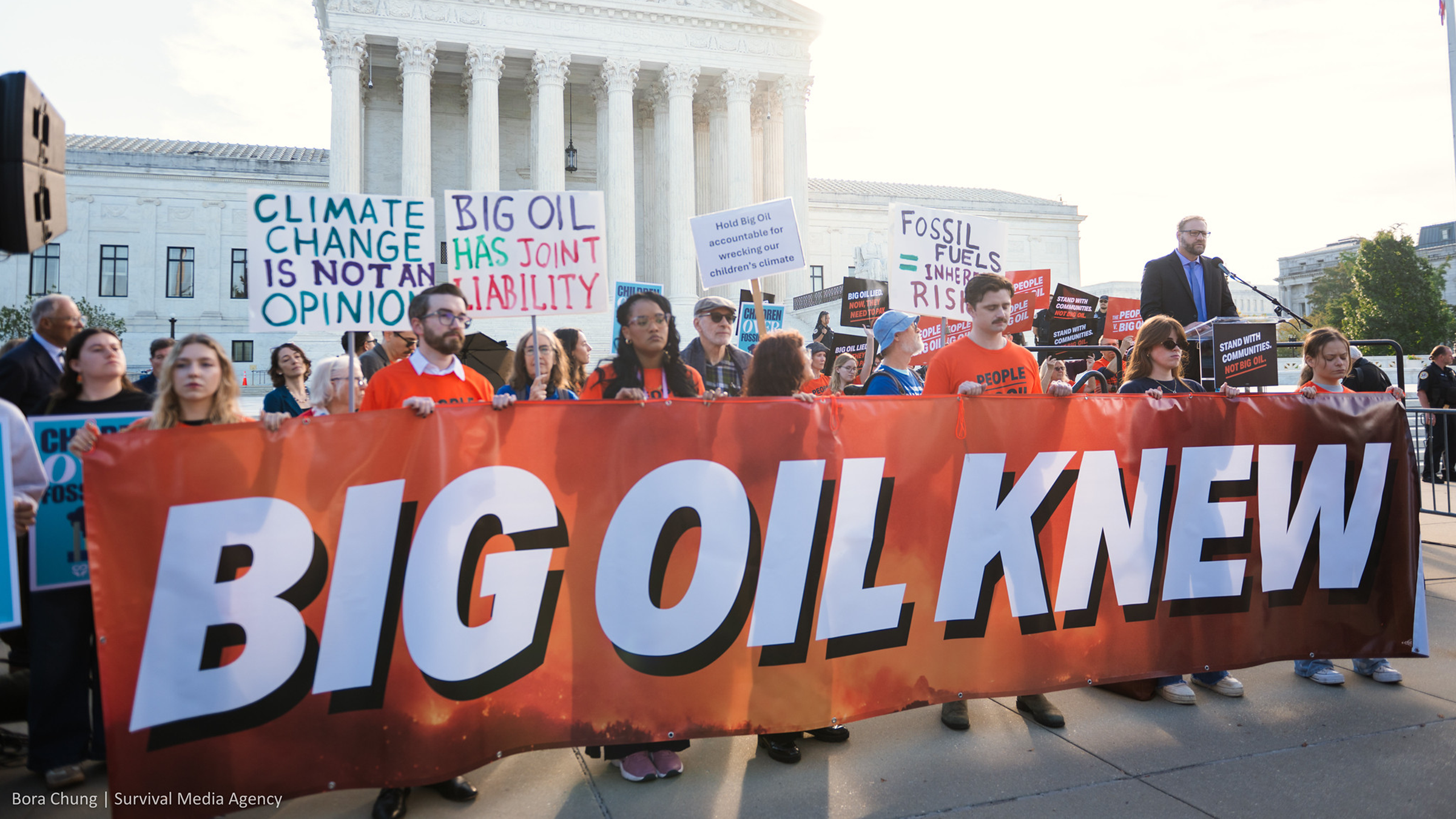
More than 100 people rallied in front of the U.S. Supreme Court ahead of the arguments to urge the justices to allow Boulder to present the evidence of Big Oil’s deception in court. The rally featured Colorado ranchers whose livelihoods are threatened by climate change and survivors from both the Marshall Fire in Colorado and Eaton Fire in California, emphasizing the growing number of communities facing massive costs to adapt to and recover from extreme weather fueled by climate change. A decision in Boulder’s case could have significant impacts for the dozens of similar climate accountability cases filed by communities across the country.
Voices from across the country gathered in front of the U.S. Supreme Court today to show their support for communities that are paying the price for Big Oil’s climate lies and demanding accountability. #PeoplevBigOil �� Kevin Wolf/AP
— Center for Climate Integrity (@climateintegrity.org) October 5, 2026 at 2:34 PM
[image or embed]
“Boulder’s case is about holding corporations accountable for deceptive conduct, and the people of Boulder should have their day in court to present the evidence of Exxon and Suncor’s deception,” Riday-White said.
Multiple justices grilled the oil industry on their argument that federal law preempts state law claims like Boulder’s:
Justice Kagan raised questions about Exxon and Suncor’s claims that Boulder’s case is preempted by constitutional principles. "Where's the text for that? Where’s the support for that? Where’s the precedent for that? Where’s the anything for that?”
Justice Sotomayor pointed out that Boulder’s case centers on the oil companies’ deceptive behavior, which has long been an area of law governed by states: “The Clean Air Act does not regulate marketing or advertising of fuel … It’s not clear to me how regulating the production and false advertisement of oil affects air and water.”
Chief Justice Roberts pointed out that there’s a long history of state courts hearing tort claims like Boulder’s: “Conduct that could have impacts in many states, all of the states, we still allow, in many of these situations, people to file in their state to seek relief from injuries that are occurring in their state.”
Justice Barrett characterized one of the oil companies’ arguments over federal preemption as “a little slippery.”
Some justices also expressed skepticism that the Supreme Court has the authority to hear the appeal of a decision before the Colorado courts have issued a final judgment on the merits. When they granted the industry’s petition, the justices themselves added a question about whether they have jurisdiction to rule on the case at this stage.
During the argument, multiple justices, including Justice Thomas, raised questions about whether it was premature for the Supreme Court to take the case at this early stage.
“We’re really early in this case,” said Justice Jackson. “I wonder whether we should be considering matters like this essentially piecemeal? . . . Why shouldn’t we wait and hear all of these claims once the state courts are done with their federal considerations?”
The high court also drew parallels between Boulder’s climate accountability lawsuit against Big Oil and previous Big Tobacco and Big Pharma lawsuits, with Justice Kagan calling it “Chapter 3” in a line of cases beginning with those against tobacco and opioid companies for their deceptive actions.
“This is the same kind of lawsuit against the same kind of actors for the same kind of harm,” Justice Kagan said. “And I guess I’m not understanding how this one would be preempted and the other is not?”
Justice Kavanaugh expressed concern that climate deception lawsuits could “bankrupt” Big Oil companies. But the history of tobacco and opioid litigation shows why that concern is unfounded. Tobacco companies can still sell their products. Doctors can still prescribe opioids. But the successful lawsuits against both industries exposed their deception, forced them to stop lying about their harmful products, and made them pay damages for the harm they caused. Boulder seeks the same accountability for Big Oil. Justice Kavanaugh’s question of financial consequences for Big Oil companies, while often touted by the fossil fuel industry, is outside of the crux of the legal questions before the high court: does Boulder get the opportunity to present the evidence of Big Oil’s lies in court?
Rally speakers outside the court urged the justices to allow Boulder’s case to move forward and called on Big Oil to be held accountable for lying to the public for decades about the harms of their fossil fuels.
Colorado ranchers, Dr. Kathryn Bedell and Deirdre Macnab, sounded the alarm of how climate change is threatening their livelihoods and, in turn, the food system in America. Survivors of the 2021 Marshall Fire — Daryl McCool, Louie Delaware, Tawnya Somauroo, Jenny Singer-Rupp, Alina Miranda, and Madison Schink — shared the devastation of losing their homes, neighborhoods, and neighbors to the historic fire that scientists found was made more destructive by climate change.
“It is profoundly unfair that oil companies keep the profits while me and my neighbors are left with the losses and the cost of adapting,” said Somauroo. “After everything my community has been through, we deserve our day in court.”
Eaton Fire survivors Gayle Nicholls-Ali, Rasheed Ali, and Zaire Calvin emphasized that Boulder is one of many communities that is struggling to rebuild in the wake of extreme weather.
Speaking before a packed crowd in front of the Supreme Court, Calvin spoke about the devastation he experienced losing his sister to the 2025 Eaton Fire.
“Before there was a claim, there was a person,” Calvin said. “Before there are damage calculations, there is a family. Before there is a case number, there is a life that mattered. Boulder is asking ‘who should pay for the damage?’ Families and taxpayers alone, or the companies responsible for their share?”
“Companies!” the crowd called out.
Watch the full recording of the rally here.
Dozens of people also gathered in Boulder, Colorado, for a local rally on Monday, echoing calls for the Supreme Court to allow the local case to move forward. The crowd held signs urging the court to “Stand with communities, not Big Oil.”