News & Analysis
March 2, 2026
On October 5, the U.S. Supreme Court will hear two fossil fuel companies’ arguments for why they should not stand trial in one of a growing number of lawsuits that seek to hold Big Oil companies accountable for their climate lies and make them pay for the damage they have caused.
In Board of County Commissioners of Boulder County et al. v. Suncor Energy (U.S.A.), Inc. et al., the City and County of Boulder, Colorado, are suing ExxonMobil and Suncor Energy to make the companies pay for the cost of local climate damages that have been fueled by their climate deception. Last year, the Colorado Supreme Court ruled 5-2 that Boulder’s case should move into discovery and proceed toward trial. Now the U.S. Supreme Court has granted Exxon and Suncor’s plea to review that decision.
No matter how the high court rules, its decision will have an important impact on climate accountability efforts across the United States — but it’s complicated. Here is what you need to know.
How did we get here?
More than 1 in 4 Americans now live in communities that are taking Big Oil companies to court to hold them accountable for their well-documented efforts to deceive the public about the dangers of fossil fuels. As many of these cases, including Boulder’s, get closer to trial, the fossil fuel industry and its allies have repeatedly asked the U.S. Supreme Court to help them escape accountability. But since issuing a very narrow, procedural ruling in Baltimore’s case in 2021, the justices have declined five different requests to revisit the cases — until now.
What is at stake in Boulder’s lawsuit?
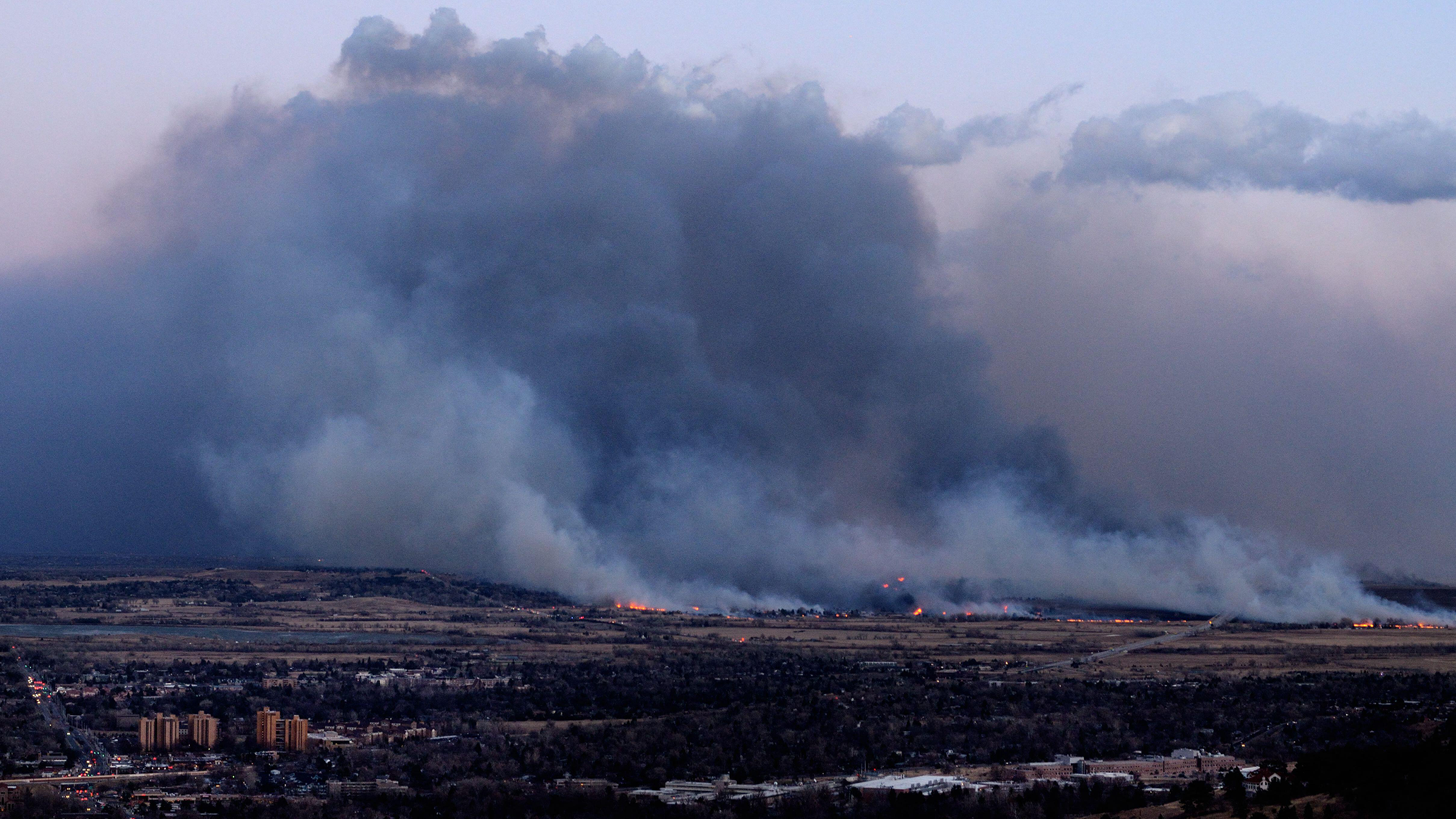
Like other communities across the country, Boulder is facing staggering costs to protect residents and infrastructure from climate damages. In 2021, more than 1,100 homes and businesses in the county were destroyed in the deadly Marshall Fire, which scientists found was made more destructive because of climate change. A recent report estimated that climate change could cost Colorado communities up to $37 billion by 2050.
“Alone, [the City and County of Boulder] and their taxpayers cannot pay the full costs of all that is needed to attempt to mitigate the harm caused by climate change, nor should they,” Boulder’s lawsuit argues. “The costs should be shared by Exxon and the Suncor Defendants because they knowingly caused and contributed to the alteration of the climate by producing, promoting, refining, marketing and selling fossil fuels at levels that have caused and continue to cause climate change, while concealing and/or misrepresenting the dangers associated with fossil fuels’ intended use.”
What issues will the Supreme Court consider?
Exxon and Suncor have argued that Boulder’s lawsuit, which was brought in Colorado state court under state law claims, is preempted by federal law and must be dismissed. Colorado courts have thus far rejected the fossil fuel companies’ preemption arguments, but the U.S. Supreme Court has agreed to take it up.
However, the justices also said they would consider a second question: whether the Supreme Court has proper jurisdiction to hear Boulder’s case right now. The Supreme Court’s ability to consider cases on appeal from a state court is limited to those considered “final judgments.” Boulder has argued that the Colorado Supreme Court’s decision does not satisfy that requirement and it is therefore inappropriate for the Supreme Court to weigh in at this time.
What is the significance of the Court asking whether it has jurisdiction to hear the case?
Legal experts have pointed out that the inclusion of the second question could be a sign that “some of the justices want to say it’s too early to take up this case and that they should wait until there’s a final judgment, presumably after a final trial and exhaustion of state appeals,” Michael Gerrard, director of the Sabin Center for Climate Change Law at Columbia University, told E&E News.
"We should not be too quick to assume that the court has taken this case because there are necessarily five votes to make the litigation go away," Jonathan Adler, an environmental and administrative law professor at William & Mary Law School, told Law360. "I think there's a lot more going on here."
How have other courts ruled on Big Oil’s federal preemption arguments?
The Hawai`i and Colorado Supreme Courts have both rejected Big Oil’s preemption arguments, finding no merit to the suggestion that climate deception cases like Boulder’s somehow seek to set national climate policy or regulate greenhouse gas emissions and are therefore preempted by federal law. Last year, the U.S. Supreme Court declined to hear Big Oil’s request to overturn the Hawai`i Supreme Court ruling that allowed Honolulu’s similar case to advance toward trial. The Hawai`i Supreme Court found that Honolulu’s lawsuit “clearly seeks to challenge the promotion and sale of fossil-fuel products without warning and abetted by a sophisticated disinformation campaign” and that oil companies’ arguments claiming otherwise “fail.”
UPDATE: In March 2026 the Maryland Supreme Court sided with Big Oil companies and ruled that three local climate deception lawsuits were preempted by federal law. In a fiery dissent, two Maryland justices said the majority’s reasoning was based on a “false premise” and “classic strawman” argument put forward by the fossil fuel defendants. “BP and the other Defendants were not sued because of what they emitted,” Justice Peter Killough wrote in a dissent joined by Justice Shirley Watts. “They were sued over what they concealed.”
Why is Boulder’s case not preempted by federal law?
Exxon and Suncor argue that Boulder’s case is seeking to regulate greenhouse gas emissions, and is therefore preempted by the Clean Air Act and/or the structure of the U.S. Constitution itself. But Boulder’s complaint states plainly that the local governments “are not asking [the] Court to stop or regulate the production of fossil fuels in Colorado or elsewhere, and they are not asking this Court to stop or regulate emissions in Colorado or elsewhere; they ask only that Defendants help remediate the harm caused by their intentional, reckless and negligent conduct, specifically by paying their share of the costs Plaintiffs have incurred and will incur because of Defendants’ contribution to alteration of the climate.”
A Colorado trial court agreed with Boulder’s articulation of its own case, finding that "the Energy Companies are arguing against a case the Local Governments did not plead.” The Colorado Supreme Court then affirmed that decision and ruled that the case should proceed toward trial. "We reject [Exxon and Suncor’s] contention that Boulder’s action is, in essence, an attempt to regulate GHG emissions and is therefore preempted,” the Colorado Supreme Court ruled. “As a factual matter, Boulder’s claims do not seek to regulate GHG emissions … Rather, they seek compensation for allegedly tortious conduct."
What impact could a decision have on other climate deception lawsuits?
No one knows how the justices will ultimately rule in Boulder’s case. If the Court decides it does not have jurisdiction to hear the case at this time, the justices will not consider the merits of the preemption argument. In this scenario, all other cases will proceed as though none of this happened. If the justices do get to the merits of the preemption question, there is a wide range of possible outcomes, making it difficult to predict the exact impact.
Different lawsuits against Big Oil are brought under different state and federal laws and theories, so it’s also difficult to assess what other cases could be impacted, or how. While the Supreme Court considers Boulder’s case, Big Oil defendants are asking for similar lawsuits to be put on pause until the Supreme Court issues a ruling – state court judges will decide whether to grant those requests on a case by case basis. It is important to remember that the laws and legal precedents communities are using to hold Big Oil accountable have not changed simply because the Supreme Court is reviewing Boulder’s case, and state and local governments have the right to continue litigating their respective cases in the meantime.
How could the Trump administration’s revocation of the EPA’s endangerment finding impact this case?
Just a few weeks before the U.S. Supreme Court agreed to hear Boulder’s case, the Trump administration rolled back the Environmental Protection Agency (EPA) rule underpinning the federal government’s authority to regulate greenhouse gas emissions, known as the “endangerment finding,” which determined greenhouse gas emissions to be a threat to public health. While Big Oil argues that the EPA’s comprehensive regulation of greenhouse gas emissions preempts Boulder’s state law claims, EPA is claiming that the federal government lacks authority to regulate greenhouse gas emissions at all. Legal experts say that the rollback makes the arguments from communities like Boulder that they have a right to seek damages under state law “stronger” and makes Big Oil’s arguments for federal preemption “unquestionably weaker.”
“I don’t see how oil companies can, with a straight face, any longer make that argument,” Pat Parenteau of Vermont Law School told the Guardian.
Isn’t Big Oil lobbying Congress for immunity in these same cases?
Yes. Big Oil’s all-out efforts to escape accountability do not end at the Supreme Court. The fossil fuel industry and its allies have spent the last year asking the Trump administration and Congress for a “liability shield” that would essentially put oil companies above the law entirely. The American Petroleum Institute, the biggest oil lobbying group and a defendant in many cases, has made killing climate lawsuits a top priority for 2026, and one member of Congress has already vowed to introduce such a bill. [Update: Republican lawmakers introduced a bill in April.]
As CCI President Richard Wiles said, “If fossil fuel companies have done nothing wrong, why have they spent the last year lobbying Congress for immunity?”
Read more CCI blogs about the upcoming arguments in Suncor v. Boulder in Related News below.