News & Analysis
August 4, 2026
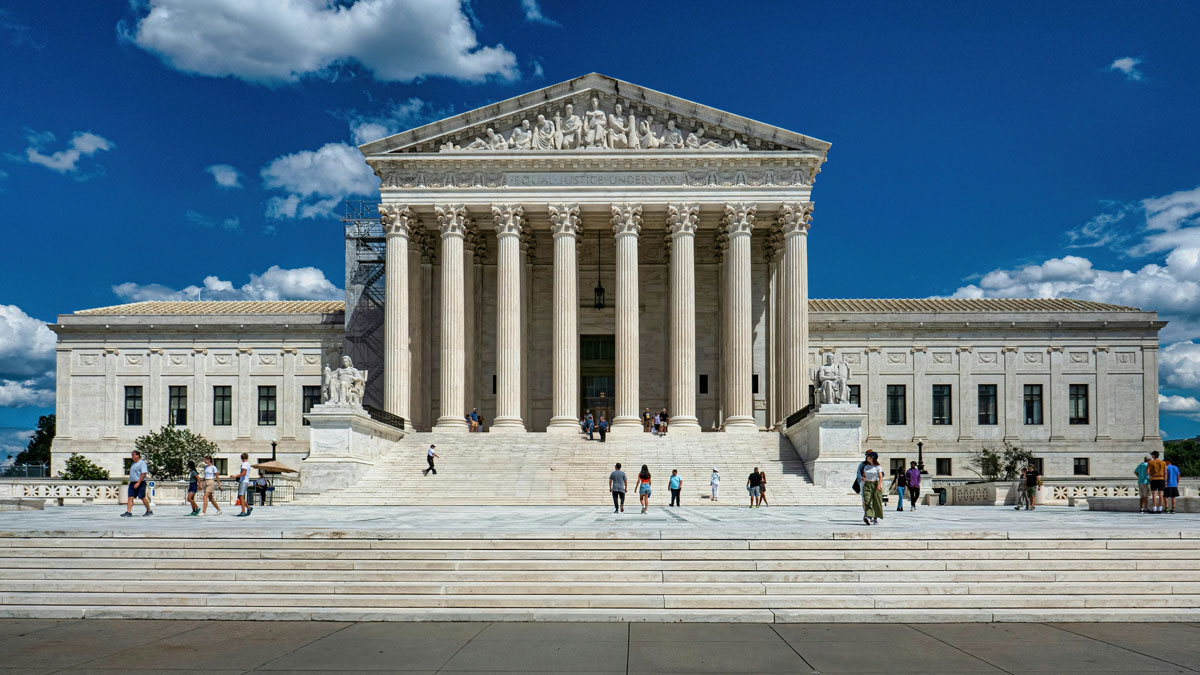
Congressional leaders, legal scholars, deception historians, attorneys general, tribes, ranchers, elected officials, and more filed dozens of legal briefs this week in support of Boulder, Colorado’s climate deception case that will be heard by the U.S. Supreme Court on October 5. The briefs calling on the justices to allow Boulder to put ExxonMobil and Suncor Energy on trial focused on two key arguments: Boulder’s case is not preempted by federal law, and it would be premature for the Supreme Court to weigh in before a final judgement has been reached in the case.
Boulder is seeking to hold the two major oil companies accountable for concealing the dangers of their fossil fuel products and to make them pay for the resulting local harms. This fall, the justices will hear Exxon and Suncor’s arguments to overturn last year’s Colorado Supreme Court decision that allowed the case to move into discovery. Last week, Boulder filed its final response brief with the Court before oral arguments.
Here are some highlights from the dozens of experts, officials, and impacted community members calling on the Supreme Court to let Boulder’s case move forward.
90 Members of Congress, led by Senator Sheldon Whitehouse and Representative Pramila Jayapal, told the Court that the answer to Big Oil’s claim that federal policy preempts Boulder’s lawsuit is “plainly no.” “In the Clean Air Act, Congress created a comprehensive and detailed system for reducing air pollution,” they wrote. “It did not address deceptive marketing or sales of fossil fuels at all.”
The members of Congress also noted that many of the briefs written in support of Exxon and Suncor were authored by groups or people that have received funding from fossil fuel-linked donors: “These amicus briefs present as an outpouring of support for a legal position, but publicly available information shows them to be funded by a small and powerful phalanx of self-interested entities,” the congressional members write. “These industry front groups and their funders are part of a tightly connected web of organizations dedicated to protecting fossil fuel interests in Congress, at executive agencies, and in the courts.”
Colorado Attorney General Phil Weiser and the attorneys general of 18 other states emphasized the long history of state law being used to hold companies accountable for their widespread harm, including Big Tobacco, opioid, and lead paint cases. “These examples underscore the traditional role of state tort law in holding large corporations accountable when they inflict broad-based harms on States and their residents,” the attorneys general said. “State legislatures and courts, who represent and are directly accountable to those experiencing such harms, are best positioned to regulate the bounds of state tort law.” In a press release, Weiser said that “[a]t this stage of the case, it would be an overreach and improper for the Supreme Court to prevent Colorado courts from considering the merits of this litigation.”
Former EPA administrators under Republican and Democratic Administrations made clear that the Clean Air Act, which their department oversaw the implementation of, does not preempt Boulder’s claims. “At no time since the Act’s enactment in 1970 has it been applied or construed as regulating the fields of truthful advertising or consumer protection that are at issue in this case,” wrote former officials including EPA administrators under the George H.W. Bush and Obama administrations. They also noted that “the Clean Air Act’s purposes and objectives do not include protecting the fossil fuel energy market,” nor would a ruling in Boulder’s favor require Exxon or Suncor to reduce their sale of fossil fuels or their emissions, as the oil companies claim. A separate brief signed by high ranking officials from both Republican and Democratic administrations, including a former EPA administrator during the George W. Bush administration, pointed out that Exxon and Suncor “identify no treaty, statute, executive agreement, or exercise of the foreign-affairs power with which Boulder’s claims actually conflict.” As they explained: “A Colorado court applying state tort law to redress Colorado injuries to Colorado property and residents does nothing more than what our federal system has always entrusted state courts to do.”
Progressive and conservative legal scholars rebuked Exxon and Suncor’s arguments to deny Boulder its day in court. On the question of whether the U.S. Supreme Court has jurisdiction to make a decision at this stage of the case, Alan Morrison — a law lecturer at George Washington University Law School — emphasized that there are “good reasons” SCOTUS is typically limited to only reviewing final state court judgements and there is “no basis” to disregard that guidance for Boulder’s case. “Petitioners can do what everyone else does in state court: wait until the end of the litigation and seek review if this (or any other) federal question ends up mattering to the outcome,” Morrison wrote. William & Mary Law School Professor Jonathan Adler noted that, even if the Supreme Court were to decide it has jurisdiction to intervene, “the legal questions in this case are comparatively simple and straightforward.” According to Adler, “[n]othing in federal law, let alone the Constitution, preempts state-law claims seeking relief from injuries allegedly caused or exacerbated by petitioners’ conduct.”
Thirteen federally recognized Indian tribes laid out the financial strain they are experiencing trying to adapt to and survive the climate crisis that Big Oil has knowingly fueled for decades. Many of the tribes are facing costs to defend their communities against sea level rise or relocate to higher ground altogether, including the Makah Indian Tribe and Shoalwater Bay Indian Tribe that are both separately suing Exxon and other oil companies. Just a selection of tribes are facing an estimated $8 billion to recover from and prepare for climate impacts, meaning that “the total amount of federal funds thus far provided to all tribes threatened by climate disruptions, under $400 million, does not even match the costs for a single tribe that must migrate to escape them.”
“State courts and state tort laws provide a mechanism by which Indian tribes may at least be able to cope with the financial aspects of this crisis,” the tribes wrote.
Colorado ranchers, for whom “climate change is not an abstract possibility, but a lived reality that is threatening the economic viability of a way of life that has been central to communities for generations” also called on the court to allow Boulder’s case to move forward, raising their “fear that if municipal government keeps absorbing the increasing costs imposed by heat, drought, fires, and flooding, it will not be able to provide the services on which they depend to continue ranching.”
Experts on the fossil fuel industry’s historic and ongoing deception detailed how Big Oil’s disinformation campaign served to preserve “demand for fossil fuel products by delaying public understanding and acceptance of climate science.”
“Their own research confirmed that continued fossil fuel production and use posed severe and potentially irreversible risks, that meaningful reductions in greenhouse gas emissions would ultimately be necessary, and that delaying action would substantially increase those risks,” scholars including Ben Franta, Naomi Oreskes, and Robert Brulle wrote. “It was against this backdrop of internal scientific certainty that Petitioners chose to publicly emphasize and misrepresent uncertainty regarding the causes, magnitude, and consequences of climate change.”
Former California Insurance Commissioner Dave Jones explained how climate change is upending insurance markets and that limiting the ability of communities to recover losses from responsible parties “would create more unpredictability, not less, in the insurance market.” “Preempting state tort law for climate-related injuries will force property owners— including public entities acting on their own behalf and for their residents—to rely exclusively on insurance and taxpayer funds to remediate property damage,” he wrote. “Those same limits could prevent insurers from utilizing the longstanding practice of subrogation to recoup losses paid to policyholders. Thus, disallowing the state law claims at issue here could interfere with insurance business practices, introducing federal constraints on an area that, like tort law, is typically left to the states.”
A trio of climate economists described climate change as an example of an economic externality not fully borne by those who contribute to it, and they debunked the claim that imposing damages liability on responsible parties would somehow destabilize the economy.
“Nuisance, trespass, and related doctrines have for centuries performed the function that economists later described analytically: requiring polluters, in appropriate circumstances, to bear costs they would otherwise impose on neighbors,” they wrote.
Former Pentagon lawyer Robert S. Taylor, a highly decorated, high-ranking lawyer for the Department of Defense under the Clinton, W. Bush, and Obama administrations, called industry arguments that Boulder’s case could somehow restrict fuel supplies for the U.S. military “absurd” and “utter nonsense.” Taylor said “a jury verdict for [Boulder] would not require [Exxon and Suncor] to produce one drop less fuel; it requires only that they tell the truth about what they know and pay damages for the harm they have caused by failing to tell the truth.” The Armed Forces have no “interest in shielding [Exxon and Suncor] from liability for what they told the public—or did not tell the public—about the climate consequences” of their products, he explained.
Gun violence reduction groups, the Brady Center to Prevent Gun Violence and Giffords Law Center to Prevent Gun Violence, pointed to the long history of municipalities bringing common law litigation against parties to address local harms that have national, or even international, reach, such as lawsuits against firearms, tobacco, and opioid manufacturers.
That same point was echoed by nonpartisan groups representing local governments, the Local Government Legal Center, National Association of Counties, National League of Cities, and International Municipal Lawyers Association wrote that local governments have a responsibility to act when “faced with deceptive and injurious conduct” and that the Supreme Court should not shut the courthouse doors to communities, as Exxon and Suncor wish them to. “When other industries have engaged in similar misrepresentations about the safety or healthfulness of their products, no preemptive effect has stopped those lawsuits – and none should here.”
Other groups that filed briefs in support of Boulder included the National Resources Defense Council, Public Citizen, American Association of Justice, Our Children’s Trust, WHEN Justice, and the Constitutional Accountability Center, along with the governments of New York City and local governments or their legal officers representing more than six million residents in California, Hawaii, Illinois, and New Jersey.